2026 Best Glass Bottle Stoppers for Global Buyers?

Time:2026-09-23 Author:Isabella
0%

Choosing the right glass bottle stopper in 2026 requires more than attractive product photography. Global buyers must examine fit, sealing performance, material quality, and supplier reliability. A well-made Bottle Stopper Glass can protect aroma, reduce leakage, and improve the presentation of wine, spirits, oils, or specialty beverages.

Practical evaluation starts with the bottle neck. Measure the opening carefully, because small differences can cause loose fits or difficult removal. Check the glass, silicone, cork, or stainless-steel components for cracks, odors, staining, and uneven finishing. A stopper may look elegant on a sample bottle but perform poorly during transport. That lesson is easy to overlook.

Reliable suppliers should provide clear specifications, batch information, packaging details, and suitable food-contact documentation where required. Buyers should also request samples before placing larger orders. Test them in realistic conditions, including refrigeration, storage, repeated opening, and vibration during shipping. Humidity and temperature changes can expose weaknesses that factory photos hide.

No stopper is perfect.

This guide compares important options for international purchasing, including reusable designs, decorative styles, airtight models, and custom solutions. It considers usability, breakage risk, order quantities, packaging protection, and communication with manufacturers. Pricing matters, but the cheapest option may create higher replacement costs later. Even experienced buyers can misjudge a product when they focus too heavily on appearance. Careful testing remains the safer approach.
2026 Best Glass Bottle Stoppers for Global Buyers?

What Are Glass Bottle Stoppers and Why Do Buyers Need Them?

Glass bottle stoppers are removable closures designed to fit inside a bottle neck. They may use solid glass, or a glass top joined with cork, silicone, or another sealing material. Their job is simple: reduce leakage, limit air exchange, and protect the bottle’s contents from dust. A well-made stopper should feel balanced in the hand and enter the neck smoothly. Too tight, and removal becomes difficult. Too loose, and the seal may fail during transport.

Buyers need them for product protection, presentation, and repeated use. In sourcing projects, small measurements matter. Check the bottle’s inner neck diameter, stopper length, sealing surface, and weight before approving samples. A stopper that looks elegant on a sample bottle may wobble on another production batch. That mistake is easy to miss.

Glass also adds visual value. Clear or colored surfaces can catch light on a retail shelf, while a heavier design may suggest better quality. However, added weight increases shipping costs and breakage risks. Request dimensional drawings, material specifications, packaging details, and suitable safety documentation for the intended market. Food-contact requirements can vary by country, so buyers should verify them with qualified local professionals. Practical testing helps too. Fill sample bottles, turn them upside down, shake them gently, and inspect the seal after several days. Aesthetic appeal matters, but reliable fit matters more.

Which Glass Bottle Stopper Materials and Designs Are Available?

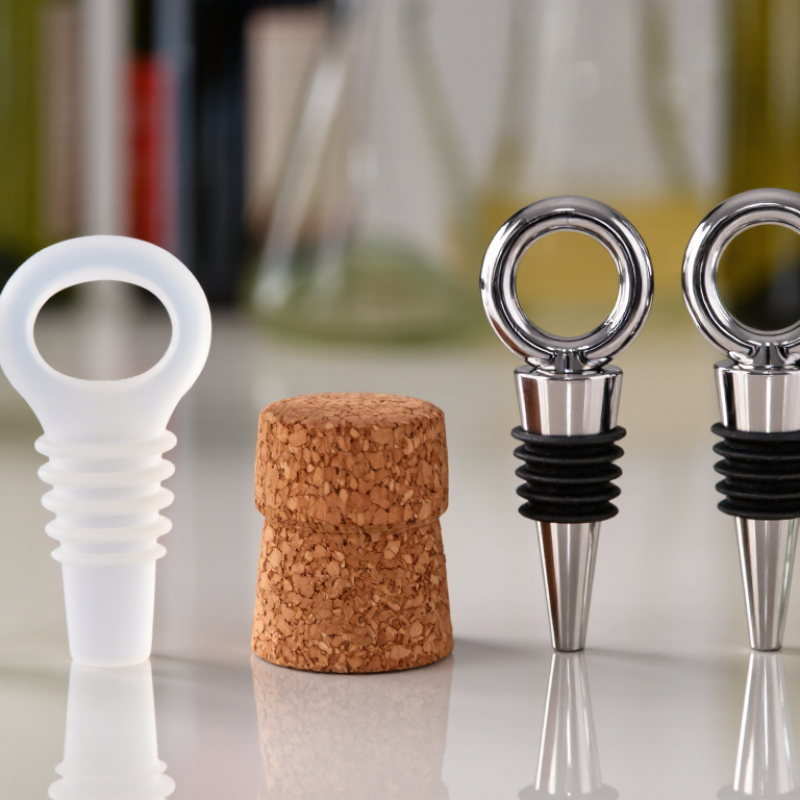
In 2026, glass bottle stopper selection depends on material compatibility, neck dimensions, and daily handling. Borosilicate glass offers strong thermal resistance and a clean, laboratory-like appearance. Soda-lime glass costs less and suits many beverage, oil, and syrup containers. Crystal-style glass adds weight and visual sparkle, but it may be less practical for frequent transport.

The sealing element changes performance significantly. Natural cork provides a warm, traditional feel and allows slight air exchange. Silicone gaskets create a tighter seal and resist moisture, staining, and repeated washing. Food-grade rubber can work well, although odor transfer should be checked before purchase. Some stoppers combine a glass body with a stainless-steel or wooden top. These designs improve grip, but mixed materials require careful durability testing.

Common designs include ground-glass stoppers, T-shaped stoppers, ball stoppers, and bar-top styles. Ground-glass surfaces can seal smoothly when the bottle neck is accurately matched. T-shaped tops are easier to pull from narrow openings. Bar-top designs usually include a flexible gasket and offer quick, repeated access. Measure the inner neck diameter and sealing depth, not only the bottle’s outside width. A stopper that looks perfect may still wobble or leak. In practical sampling, I would test filled bottles upside down, after washing, and after temperature changes. This takes time. It also exposes weak tolerances that product photos cannot show.

How to Compare Sealing Performance, Durability, and Compatibility

Choosing the best glass bottle stopper starts with sealing performance, not appearance. A reliable stopper should create even contact around the bottle neck. Check for leaks with water, gentle shaking, and a 24-hour standing test. Natural cork can adapt well, while silicone offers consistent flexibility. However, material softness may change in hot or cold storage.

Durability also deserves practical testing. Inspect the stopper after repeated insertion and removal. Look for cracks, compression marks, loose parts, or fading. A smooth glass neck may need a different fit than a threaded or uneven opening.

Measure the inner diameter, neck depth, and mouth shape before ordering. Small differences matter. I once saw a stopper that fitted tightly at room temperature but loosened after refrigeration. That result changed my testing process.

Tips: Request samples from several suppliers. Test them with your actual bottles, liquids, and storage conditions. Check odor transfer, cleaning response, and resistance to moisture. Ask for material specifications, dimensional tolerances, and batch inspection records. Food-contact documentation should match the destination market. Yet paperwork is not enough. A certificate cannot replace a physical fit test. Also, avoid judging quality from weight alone. A heavier stopper may feel stronger but seal poorly. Some evaluations remain imperfect, especially when bottle dimensions vary between production batches. Review those limitations before making a large purchase.

What Standards Should Global Buyers Check Before Purchasing?

2026 Best Glass Bottle Stoppers for Global Buyers?

What Standards Should Global Buyers Check Before Purchasing?

Global buyers should treat a glass bottle stopper as a safety component, not a decorative accessory. The OIV’s 2023 sector report recorded about 221 million hectolitres of global wine consumption. At this scale, a small sealing defect can create widespread leakage, oxidation, or customer complaints.

Check the stopper’s food-contact compliance for each destination market. In Europe, suppliers should address Regulation (EC) No 1935/2004 and good manufacturing practice under Regulation (EC) No 2023/2006. Buyers should also request migration testing, odor and taste evaluation, dimensional inspection, and batch traceability. For elastomer parts, ask about composition, compression recovery, temperature resistance, and chemical compatibility. For cork-based parts, moisture control and sensory testing deserve attention. “Food grade” alone is not enough.

Tips: Request recent laboratory reports, not only certificates. Confirm the test sample matches the production material. Test the stopper with the actual bottle neck, liquid, storage temperature, and closing equipment. ISO 2859-1 sampling can support incoming inspection, but it cannot replace performance testing. One weakness remains: laboratory results may not predict every warehouse condition. Humidity, transport vibration, and repeated opening can expose problems. Buyers should record these field results and challenge their own assumptions.

2026 Best Glass Bottle Stoppers for Global Buyers? - What Standards Should Global Buyers Check Before Purchasing?

Evaluation Dimension Glass Stopper Natural Cork Stopper Silicone Stopper TPE Stopper What Global Buyers Should Check
Primary material Soda-lime or borosilicate glass Natural cork or agglomerated cork Food-contact silicone rubber Food-contact thermoplastic elastomer Request the exact material grade, additives, coatings, pigments, and supplier declaration of composition.
Typical use case Premium spirits, oils, decorative bottles, reusable packaging Wine, spirits, and products where a compressible natural closure is preferred Reusable bottles, sauces, beverages, and leak-resistant closures Lightweight closures requiring flexibility and lower material cost Match the stopper to product viscosity, storage time, opening frequency, and bottle-neck design.
Common bottle-neck compatibility Designed for a specified bore and sealing land Usually requires a controlled cylindrical or tapered bore Works with a wider dimensional tolerance when properly designed Requires verified compression and interference fit Confirm neck finish, bore diameter, bore depth, sealing surface, and stopper insertion depth using drawings and samples.
Typical stopper diameter range Approximately 15–30 mm for small and medium bottle formats Approximately 18–24 mm for many wine-style applications Approximately 18–35 mm, depending on the sealing profile Approximately 18–35 mm, depending on the bottle neck and cap geometry Treat these as indicative ranges only; approve production dimensions against the actual bottle-neck drawing.
Temperature resistance Excellent temperature stability; thermal-shock performance depends on glass type and design Generally suitable for ambient storage; excessive heat and drying can affect performance Often suitable for approximately −40°C to 200°C, subject to the specific grade Often suitable for approximately −30°C to 120°C, subject to the specific grade Check the supplier's validated temperature range and perform thermal-cycle testing for the intended filling and storage conditions.
Chemical and odor resistance Generally high chemical resistance and low odor transfer Natural variability; can influence aroma if quality or storage is poor Good resistance to many water-based products; compatibility depends on formulation Compatibility varies with oils, alcohol, solvents, and acidic products Request sensory testing, extractables or migration data, and product-specific compatibility results.
Leakage performance High when the stopper and bore are precision matched; rigid glass cannot compensate for dimensional variation Good compression seal when moisture content, diameter, and bore are controlled Very good elastic sealing and repeated-use performance Good sealing with correctly designed compression and material hardness Require upright, inverted, vibration, pressure, and repeated-opening leak tests using filled bottles.
Mechanical durability Rigid and wear-resistant but vulnerable to impact, chips, and breakage Compressible and lightweight; may deform or shed particles if poorly manufactured Flexible and suitable for frequent opening and closing Flexible and lightweight; long-term compression set must be evaluated Check drop resistance, insertion force, removal force, compression set, abrasion, and dimensional change.
Food-contact regulatory checks EU Regulation (EC) No 1935/2004; EU GMP Regulation (EC) No 2023/2006; applicable national rules EU food-contact framework; applicable requirements for cork and treatment materials; destination-market rules EU Regulation (EC) No 1935/2004; relevant silicone requirements; FDA 21 CFR 177.2600 where applicable EU Regulation (EC) No 1935/2004; EU Regulation (EU) No 10/2011 where the material falls within its scope; FDA rules where applicable Confirm the destination country, intended food type, temperature, contact time, and a current declaration of compliance.
Glass quality and safety standards ISO 4802 for hydrolytic resistance; ISO 7458 for internal pressure resistance where applicable; ISO 7459 for thermal shock where applicable Not applicable to the cork body; verify the glass bottle separately against the applicable glass-container specifications Not applicable to the elastomer body; verify the glass bottle separately Not applicable to the elastomer body; verify the glass bottle separately Ask for test reports covering glass hydrolytic resistance, thermal shock, internal pressure, annealing, and visual defects when relevant.
Dimensional tolerances Commonly controlled to approximately ±0.2–0.5 mm, depending on the feature and manufacturing process Natural and agglomerated cork dimensions vary by grade and compression process Often controlled to approximately ±0.1–0.3 mm on molded features Often controlled to approximately ±0.1–0.3 mm on molded features Do not rely on generic tolerances; approve a signed technical drawing and a first-article inspection report.
Cleaning and reuse Easy to wash, but inspect for chips and cracks before reuse More difficult to clean and dry; repeated reuse may reduce sealing performance Generally easy to wash and reuse when the grade is designed for repeated contact Generally washable; verify resistance to detergents, heat, and repeated cycles Define the cleaning method, detergent concentration, temperature, cycle count, and inspection criteria.
Traceability documents Batch number, material specification, inspection report, and glass test results Batch number, cork grade, moisture data, treatment details, and sensory records Batch number, compound specification, hardness, post-curing details, and migration data Batch number, polymer grade, hardness, processing information, and migration data Require lot traceability from raw material through molding, inspection, packing, and shipment.
Recommended buyer decision Best for premium appearance, inertness, and long-term visual value when breakage risk is acceptable Best when natural material, compressibility, and traditional closure performance are priorities Best for frequent reuse, flexible sealing, and broad temperature performance Best when lightweight design, flexibility, and cost control are important Select only after document review, dimensional approval, product-contact testing, and filled-package validation.
Buyer note: Standard applicability depends on the stopper material, bottle design, product category, filling process, and destination market. Request current test reports and declarations of compliance for the exact production material and configuration.

How to Select Suppliers, Customize Orders, and Control Costs?

For global buyers in 2026, selecting a glass bottle stopper starts with the supplier, not the catalog. Ask for factory photos, production capacity, quality records, and recent sample dates. A serious supplier should explain glass type, stopper dimensions, seal material, and tolerance limits. Request food-contact test reports for your target markets. Verify that the documents match the actual factory and product. They should. Many buyers skip this step.

Order samples from two or three suppliers. Test insertion force, leakage, odor, surface chips, and fit after refrigeration. Measure the bottle neck with a caliper. A stopper that fits one bottle may fail another mold. Ask for a small pilot batch before accepting a large minimum order. Confirm color consistency, logo placement, carton dividers, and drop-test standards in writing. Custom molds can improve fit, but tooling fees and approval delays affect cash flow. Keep a signed sample as the production reference.

Control cost through total landed cost, not unit price. Compare glass weight, packaging space, breakage rates, inspection fees, freight, duties, and replacement stock. Heavier glass feels premium, but it can raise shipping costs quickly. Negotiate staged payments and a realistic lead time. Avoid promises that sound too perfect. A low quote may hide thin packaging or unstable dimensions. I have seen buyers save two cents per piece, then lose money through damaged cartons. Recheck the numbers after customization; assumptions change. This is where careful buyers remain skeptical.

FAQS

Which materials are commonly used for glass bottle stoppers?

Borosilicate glass resists heat well and has a clean appearance. Soda-lime glass is more affordable for many containers. Crystal-style glass looks bright but may be less practical during transport.

How do sealing materials affect stopper performance?

Natural cork feels traditional and permits slight air exchange. Silicone gaskets provide tighter seals and resist moisture, stains, and repeated washing. Food-grade rubber may work, but odor transfer needs checking.

Which stopper designs are available?

Common options include ground-glass, T-shaped, ball, and bar-top designs. T-shaped tops are easier to remove from narrow openings. Bar-top styles support quick, repeated access.

How should I measure a bottle before choosing a stopper?

Measure the inner neck diameter and sealing depth. Check the mouth shape too. Outside width alone is not enough. Small differences matter.

How can I test whether a stopper seals properly?

Fill the bottle with water and turn it upside down. Shake it gently, then leave it standing for 24 hours. Check for drops, wobbling, or slow leakage.

Does temperature affect stopper fit?

Yes. Materials can soften, contract, or change flexibility in hot or cold storage. A stopper may fit tightly at room temperature but loosen after refrigeration.

How can I check stopper durability?

Insert and remove the stopper repeatedly. Inspect cracks, compression marks, loose parts, and fading. Wash it several times. That takes time.

Are product documents enough to confirm quality?

No. Request material specifications, dimensional tolerances, inspection records, and suitable food-contact documentation. Then test samples with your actual bottles and liquids. Paperwork cannot replace physical testing.

Should I choose the heaviest stopper?

Not necessarily. A heavier stopper may feel stronger but seal poorly. Test fit, handling, cleaning response, and moisture resistance instead. Weight can mislead.

What limitations should buyers consider during testing?

Bottle dimensions may vary between production batches. One sample may not represent every bottle. My testing process is not perfect, so repeated checks remain necessary.

Conclusion

Glass bottle stoppers are essential components for protecting product quality, preventing leakage, and improving the presentation of beverages, oils, cosmetics, and other packaged goods. For global buyers, choosing the right Bottle Stopper Glass requires careful consideration of materials, shapes, closure mechanisms, and intended applications. Options may include solid glass, glass combined with natural or synthetic sealing materials, and designs with smooth, textured, or decorative finishes. Buyers should compare sealing performance, pressure resistance, chemical compatibility, durability, and ease of use before placing an order.

A reliable purchasing process should also include checks for food-contact suitability, material safety, dimensional accuracy, testing records, packaging protection, and traceability according to the destination market’s requirements. When selecting suppliers, buyers should evaluate production capacity, quality-control procedures, sample consistency, customization options, and delivery reliability. Clear specifications for size, color, finish, logo treatment, packaging, and order quantity can reduce waste and control costs. A balanced decision should prioritize dependable performance and compliance rather than appearance or low price alone.


Isabella

Isabella

Isabella is a dedicated marketing professional with a sharp focus on driving brand growth and engagement through strategic content creation. With an extensive background in digital marketing, she combines her passion for storytelling with her keen understanding of industry trends to deliver......