Wholesale buyers need bottle stoppers that do more than look polished on a sample table. They must fit the bottle neck, seal consistently, and withstand repeated handling. A few millimeters can affect the fit. So can a rough edge or a loose cap. This guide compares ten options for different bottle styles, order sizes, and brand needs. It focuses on practical details: material, dimensions, closure performance, customization, and supplier consistency.
For this guide, packaging specialist Maya Chen offers this editorial observation: “A stopper earns its place when it seals cleanly, feels reliable in hand, and arrives consistent across the order.” This is a guide-specific statement, not a sourced quotation. Buyers should still request samples and test them with their own bottles. Check insertion and removal by hand. Inspect finish quality under ordinary lighting. Ask suppliers how they manage batch variation. Small checks matter.
The phrase Stopper Alcohol can cover closures with very different uses and construction. There is no single best choice for every buyer. A decorative design may impress, yet fit poorly. A simple closure may perform well but miss the brand’s visual tone. Trade-offs happen. This list weighs those details to help wholesale teams compare options with clearer expectations. No ranking can replace a real fit test. That part is easy to overlook.
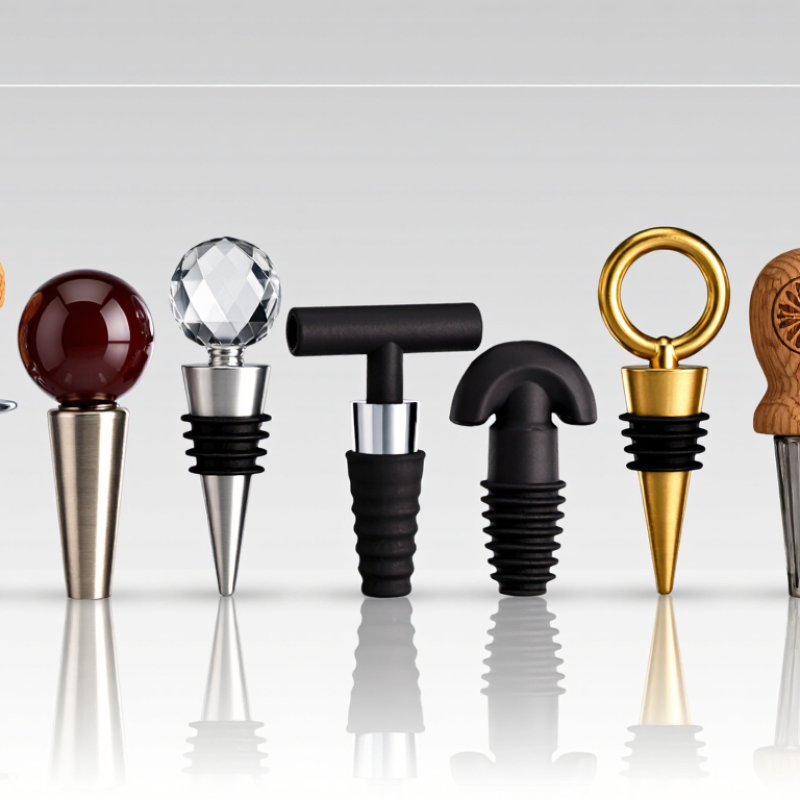
Alcohol bottle stoppers differ in sealing performance, opening feel, and reuse potential. Natural cork suits traditional wine packaging, while agglomerated cork offers more consistent sizing for high-volume orders. Synthetic polymers can provide uniform dimensions; silicone and stainless-steel combinations are common in reusable top stoppers for spirits and gift sets. Fit matters more. A stopper that slips or needs excessive force can slow packing and frustrate customers.
Material choice should follow the bottle and its use. Check neck-finish dimensions, liquid contact, storage position, and expected opening frequency before requesting samples. For a café or tasting room, a reusable T-top may be practical; for retail cartons, consistent height and secure seating help reduce movement in transit. Ask suppliers for material specifications and test samples for leakage, odor transfer, and repeated insertion. Small differences show. These checks are easy to overlook when comparing only unit prices.
Wholesale demand should be planned carefully, not inferred from stopper sales alone. The International Organisation of Vine and Wine reported 2023 global wine production of 237 million hectolitres and consumption of 221 million hectolitres in its State of the World Vine and Wine Sector in 2023 report. Those figures describe the wine sector, not closure demand, but they illustrate why buyers should avoid assuming one stopper type fits every market. A practical trial order can reveal fit issues before a larger purchase.
For wholesale buyers, stopper performance depends on the bottle neck and the drink being stored. Natural cork gives a traditional seal but may dry out and is usually single-use. Agglomerated cork is economical, though its seal can vary. Synthetic cork resists crumbling and fits many cork-finish bottles. Screw caps seal reliably when thread sizes match, and they are easy to reuse. Silicone plugs flex around some necks and wash clean, but sizing matters.
Rubber stoppers provide a snug fit for compatible openings, but can retain odors. Vacuum-pump stoppers are reusable and help limit air exposure; they suit certain wine bottles, not every shape. Lever-style wine stoppers are reusable and convenient, but their seals depend on neck dimensions. Swing-top ceramic-and-wire closures are reusable and work only with matching swing-top bottles. Pressure-rated sparkling-wine stoppers hold carbonation better than ordinary plugs, but require a compatible bottle finish. Ten types, with trade-offs.
Tips: Check neck diameter, finish, and storage conditions before ordering. Request samples and test for leakage after bottles lie on their sides. A stopper that fits one supplier’s bottle may fail on another’s. That detail is easy to overlook. Compare cleaning needs and replacement rates alongside unit price; reusable does not always mean longer-lasting.
A 750 mL capacity does not guarantee a standard neck. Before ordering stoppers, request the bottle finish drawing and check bore diameter, finish height, and sealing surface. CETIE’s GME 14.1 technical drawing treats the wine-bottle cork finish as defined geometry; ISO 12821:2013 specifies a distinct cork-mouth finish for sparkling-wine bottles. The difference matters. A stopper that fits one finish may sit too high or seal poorly in another.
For a common still-wine format, buyers often use a 24 mm diameter by 45 mm long cork as a starting specification, with a bottle bore near 18.5 mm. Treat these as reference dimensions, not universal limits. Small differences matter. For synthetic or T-top stoppers, confirm insertion depth and the dimensions of the exposed top as well. Ask suppliers for dimensional tolerances and test samples against the actual bottle lot. Measure actual samples. A tidy spreadsheet can still miss oval necks or finish variation; I have seen a nominal match become a frustrating fit at packing. Check samples upright and on their sides, then record insertion and pull-out performance before approving a wholesale run.
Compare nominal finish diameters used in common screw-finish specifications. The number before the hyphen is the nominal diameter in millimeters; the suffix identifies the thread style.
For wholesale orders: A finish code does not specify the bottle’s internal bore, so it cannot determine stopper-plug size by itself. For 750 mL bottles, confirm the bottle drawing and measure the neck opening before selecting a cork, T-top, or other stopper.
For wholesale buyers, a bottle stopper is a food-contact component, not merely a decorative finish. Check the exact material, colorants, coatings, and sealant against its intended use. FDA compliance is not a blanket approval: applicable requirements depend on the material and conditions of use under 21 CFR. In the EU, Regulation 1935/2004 requires materials not to transfer constituents in amounts that could endanger health or unacceptably alter food. Ask suppliers for material specifications, migration-test reports, and a Declaration of Compliance where applicable. Keep documents tied to the specific stopper model and production lot.
Traceability matters. The European Commission’s 2023 RASFF annual report recorded 4,683 notifications across food and feed. These were not stopper failures, but the figure underscores why documented supply chains matter. For EU plastic parts, also check whether Regulation 10/2011 applies and whether testing reflects the actual contact conditions. A report for a similar polymer is not automatically evidence for your product. Small details count.
Before approving a bulk order, compare test conditions with the intended beverage, contact time, and storage temperature. Request reports from a competent laboratory, and verify that closures still seal after fitting and removal. I would not rely on a generic “food grade” statement alone; it sounds reassuring, but may leave key questions unanswered. Keep samples, lot records, and supplier declarations together for review.
Wholesale buyers should assess cork stoppers with comparable evidence, not appearance alone. For cork-based models, request test reports that identify the ISO 9727 method, sample size, and production lot. Relevant checks may include dimensions, moisture content, density, liquid tightness, and extraction force. These results help explain whether a stopper fits the neck consistently and can be inserted and removed without excessive effort.
Small details matter. A low extraction-force result may suit one closure design but feel loose in another. Compare samples against your bottle’s neck finish and filling process. Ask suppliers how they handle out-of-spec results and whether test data represents routine production. A clean lab report cannot predict every filling line; it is evidence, not a guarantee. Synthetic stoppers also require material-appropriate evaluation rather than automatic comparison with cork test results.
MOQ and unit cost belong in the same decision. Request pricing at several order quantities, then include freight, packaging, inspection, and expected rejects in the landed cost. A lower unit price may require more inventory than your warehouse can turn quickly. Compare the quoted MOQ with a realistic sales forecast, and confirm whether repeat orders retain the same specifications. Cheap can be costly. Some buyers still overvalue the first quote; that is an easy mistake to make.
Match the material to the bottle and use. Natural cork suits traditional wine packaging, while silicone-and-steel tops work well for repeated use. Test the fit first.
Measure the bottle neck and try samples during insertion and removal. A stopper that slips or takes excessive force can slow packing. Small differences matter.
Check for leakage, odor transfer, and sealing after repeated use. Try the stopper with the intended beverage and storage conditions. Keep a sample from each lot.
Ask for material specifications, relevant migration-test reports, and applicable compliance declarations. Tie each document to the exact model and production lot. “Food grade” alone is vague.
Request test results showing the method, sample size, and production lot. Check dimensions, moisture, density, liquid tightness, and extraction force. A report is useful, not a guarantee.
No. Cork and synthetic materials need appropriate evaluations. Compare samples with your bottle neck and filling process, rather than relying on one number.
Request prices at several order quantities. Add freight, packaging, inspection, and likely rejects to the unit cost. I might still overvalue the first quote; warehouse space matters too.
Compare the minimum with a realistic sales forecast and storage capacity. Ask whether repeat orders keep the same specifications. Cheap can be costly.
This guide helps wholesale buyers evaluate ten alcohol bottle stopper types, from natural cork and synthetic closures to reusable screw, silicone, and mechanical designs. It compares sealing performance, reusability, durability, and compatibility with different bottle openings, highlighting how the right Stopper Alcohol choice depends on the intended use, packaging format, and expected storage conditions.
Before placing an order, buyers should match stopper dimensions to 750 mL bottle openings and confirm the relevant neck-finish specifications. The guide also outlines how to review food-contact documentation against FDA 21 CFR requirements and EU Regulation 1935/2004, and how ISO 9727 tests can help assess cork performance. Finally, it explains how to compare minimum order quantities and unit costs alongside quality and fit, supporting more informed wholesale purchasing decisions.

QLT Glass