China’s wine glass industry now serves restaurants, retailers, airlines, and private collectors worldwide. This guide examines China Top 10 ML Wine Glass Types for Global Buyers, with attention to capacity, bowl shape, rim thickness, packaging, and export consistency.
The OIV reported global wine consumption at approximately 214.2 million hectolitres in 2023. That decline of 2.6% increased pressure on suppliers to improve presentation and reduce unnecessary replacement costs. Meanwhile, Grand View Research identifies continued growth in premium glassware, supported by hospitality recovery and home entertaining. These trends make capacity selection more important than it first appears. A 150 ml tasting glass serves a different purpose from a 650 ml Bordeaux glass.
Georg J. Riedel, a leading wine-glass designer, has said, “The glass is the tool that allows the wine to express itself.” That principle guides this comparison. Bowl width affects aroma release. Stem length changes handling. Machine-made rims support scale, while hand-finished rims may offer a more refined feel. However, craftsmanship alone does not guarantee better commercial performance.
Actual capacities can vary between declared volume and practical serving volume. This point is easy to overlook. Buyers should request drawings, sample measurements, carton specifications, and breakage-test records before placing large orders. China offers strong production flexibility, but quality can differ between factories and production batches. The following ten Ml Wine Glass types are therefore ranked as a practical purchasing framework, not an absolute global standard. Pricing, freight, food-contact compliance, and replacement availability still require independent verification.
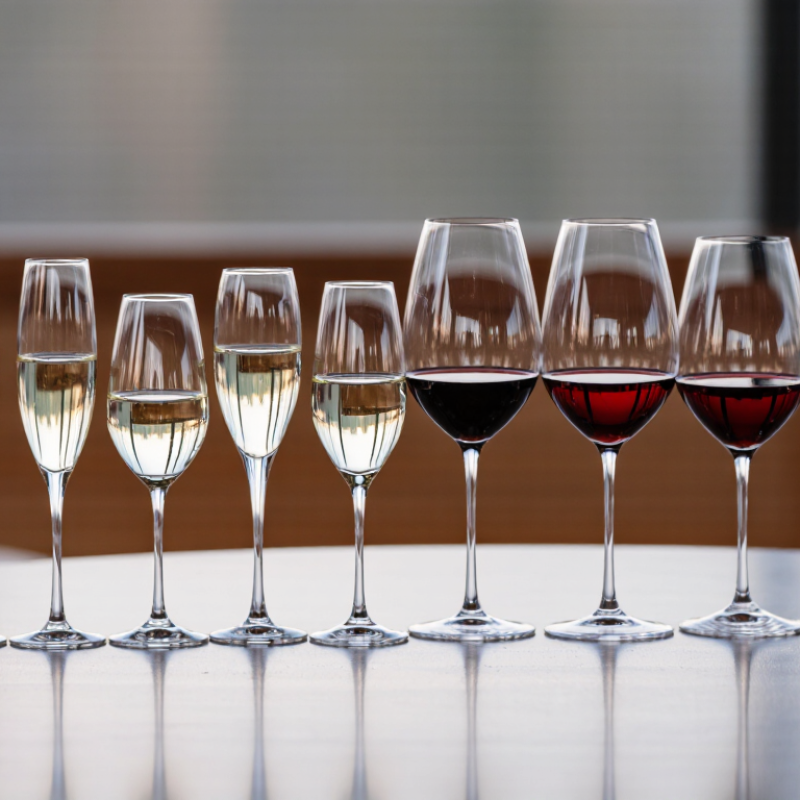
China’s wine-glass market is easier to compare when capacity comes first. In factory sourcing, milliliters usually describe brim volume, not the recommended serving size. A practical 100–750 mL taxonomy helps buyers match shape, use, packaging, and shipping requirements.
The ten common types include tasting glasses at 100–150 mL, port glasses at 120–180 mL, and dessert-wine glasses at 180–250 mL. Sparkling flutes normally hold 160–220 mL. Coupes often range from 180–250 mL. White-wine glasses commonly measure 250–400 mL. Universal glasses sit around 350–500 mL. Stemless glasses usually offer 300–500 mL. Bordeaux-style red-wine glasses reach 500–650 mL. Burgundy-style bowls can hold 600–750 mL.
Shape still matters.
A larger bowl may improve aroma release, but it also increases carton height and breakage risk. Narrow flutes can support visual bubble presentation, while their rims may feel less comfortable during long events. In production checks, buyers should inspect rim consistency, bowl symmetry, stem alignment, clarity, and base stability. Food-contact documentation and measured capacity should also match the purchase specification.
The categories overlap. A 450 mL universal glass may serve white or red wine, depending on its bowl and rim. Some factory capacity labels are approximate, so sample testing remains essential. This taxonomy is useful, but not perfect; final selection should reflect serving habits, dishwasher exposure, packing limits, and the expected guest experience.
This capacity taxonomy covers commonly manufactured wine-glass forms for global foodservice, retail, hospitality, and giftware markets. Capacities represent typical nominal bowl volumes; actual product specifications may vary by stemware design and intended serving size.
China’s top 10 ML wine glass types serve different drinking occasions and buyer needs. Bordeaux glasses have tall bowls and narrower openings, directing full-bodied red wine toward the back palate. Burgundy glasses use wider bowls, helping delicate aromas expand quickly. White wine glasses are usually smaller, keeping chilled servings controlled. Rosé glasses balance a modest bowl with a slightly tapered rim.
Flute glasses preserve bubbles through their narrow shape, while coupe glasses offer a broad, vintage-style presentation. Stemless designs improve stability on outdoor tables, although fingerprints and warmer wine can become practical concerns. Universal glasses combine red and white wine functions, making them useful for restaurants with limited storage. Dessert wine glasses hold smaller portions, and tasting glasses emphasize aroma evaluation over visual drama.
During sourcing, I check rim smoothness, bowl symmetry, stem alignment, and base stability by hand. A glass that looks elegant may still feel unstable after several pours. I also compare wall thickness, carton protection, and sample consistency before approving bulk production. Clear glass photographs well, but tiny bubbles or uneven edges can appear under showroom lighting. My own early mistake was judging shape before testing grip and washing durability. The best selection depends on service style, packing standards, target price, and the buyer’s willingness to accept small visual variations.
For global buyers comparing the top ten machine-made wine glass types, ISO 3591:1977 remains a useful tasting reference. Its classic glass uses a tulip-shaped bowl, narrow rim, stem, and stable circular foot. Common benchmark dimensions include about 155 mm overall height, a 65 mm bowl diameter, and approximately 215 ml capacity. These proportions help direct aroma toward the nose while leaving enough space for controlled swirling. They do not define every commercial glass.
The OIV’s 2024 report estimated global wine consumption at 214.2 million hectolitres in 2023. That scale increases demand for durable, repeatable glassware across restaurants, laboratories, and hospitality procurement.
Buyers should compare Bordeaux, Burgundy, white-wine, sparkling, dessert, universal, stemless, tasting, and small-pour profiles against ISO-related measurements. Rim thickness also matters. A narrow, even rim usually improves sip control, while excessive weight can reduce handling comfort.
Machine-made production can create small dimensional variations between batches. Therefore, request sample measurements, rim inspection, thermal-shock information, and packed-carton testing before approval.
A 215 ml capacity alone proves little;
bowl shape, wall thickness, and usable fill level change the tasting experience.
Some purchasing teams still treat ISO compliance as a complete quality guarantee. It is not. Standard alignment should support practical testing, not replace it.
Machine-made wine glasses commonly include Bordeaux, Burgundy, universal, white wine, champagne flute, coupe, dessert wine, tasting, stemless, and stackable styles. For global procurement, material choice often matters more than shape.
Soda-lime glass offers practical strength, stable supply, and lower unit costs. It suits restaurants, hotels, and large retail programs. However, it may look less brilliant and feel slightly heavier in the hand.
Lead-free crystal usually provides clearer light reflection, a thinner rim, and a more refined table experience. Its ringing sound can also support premium positioning. Yet, higher clarity does not guarantee better durability. Thin crystal may chip during packing, washing, or repeated handling.
A reliable factory should control rim thickness, forming accuracy, annealing, and visual inspection. Buyers should request food-contact documents, composition details, and batch traceability. These checks are not glamorous, but they prevent expensive surprises.
Tips: Compare both materials through real tests, not catalog photos. Check dishwasher cycles, thermal shock, carton drops, and stacking pressure. Ask for samples from regular production, not special samples.
In my view, soda-lime is often the safer volume choice, while lead-free crystal fits presentation-led programs. Still, this judgment can change with freight costs, washing conditions, and breakage targets. A beautiful glass that arrives chipped is not a successful purchase.
China Top 10 ML Wine Glass Types for Global Buyers?
Chinese wine glass ranges often cover ten practical capacities: 90, 120, 150, 180, 220, 250, 300, 350, 450, and 600 ml. These sizes suit tasting rooms, restaurants, hotels, and retail gift sets. Buyers should check bowl volume, usable fill line, rim thickness, stem strength, and carton protection. A 250 ml glass may look standard, but its actual capacity can vary by mould and measurement method. Small details matter.
Export compliance needs evidence, not attractive samples alone. For the EU, glass articles must meet Regulation (EC) No. 1935/2004 and support traceability and safe food contact. Good manufacturing controls under Regulation (EC) No. 2023/2006 are also relevant. For the United States, FDA 21 CFR requirements depend on materials, coatings, pigments, and intended use. A supplier should provide applicable declarations, test reports, and production records. “FDA compliant” without scope is too vague.
LFGB evaluation is often requested for the German market, especially for migration, sensory transfer, and heavy-metal concerns. Testing should match the final product, including printed areas and decorations. Inspectors may compare samples against batch records and packaging claims. In practice, a report from one glass shape cannot automatically cover every capacity. That assumption needs review. A clean-looking glass can still fail after decoration, washing, or transport. Keep drawings, material details, test dates, and lot numbers together. Mistakes happen. Traceable correction is what protects the shipment.
| No. | Machine-Made Wine Glass Type | Typical Capacity | Typical Height | Common Commercial Use | EU 1935/2004 Compliance Focus | FDA 21 CFR Compliance Focus | LFGB Compliance Focus |
|---|---|---|---|---|---|---|---|
| 1 | Bordeaux Red Wine Glass | 550–750 ml | 225–255 mm | Cabernet Sauvignon, Merlot, Bordeaux-style red wines, restaurants and hospitality. | Food-contact declaration under Regulation (EC) No. 1935/2004; glass composition and migration testing should support the intended use. | Use a food-contact-safe glass formulation and document compliance with applicable FDA food-contact provisions and good manufacturing practice under 21 CFR 174.5. | Assess extractables and heavy-metal migration under applicable German food-contact requirements, including LFGB Sections 30 and 31 and relevant BfR guidance. |
| 2 | Burgundy Red Wine Glass | 650–900 ml | 220–250 mm | Pinot Noir, Nebbiolo and aromatic red wines requiring a broad bowl. | Verify that all glass, decoration, coatings and rim treatments are suitable for repeated food contact and do not transfer constituents in harmful amounts. | Confirm that colorants, coatings, printed decoration and any external treatments are suitable for the intended food-contact application. | Request migration testing for the finished article, especially when decoration, coatings or colored glass are used. |
| 3 | Universal Wine Glass | 400–550 ml | 210–235 mm | Retail gift sets, wine tasting, catering and everyday red or white wine service. | Maintain traceability and a written declaration of compliance covering the finished glass article and its intended conditions of use. | Document the glass formulation, manufacturing controls and any applicable food-contact authorizations or exemptions. | Use finished-product testing rather than relying only on raw-material declarations; include lead and cadmium screening where relevant. |
| 4 | Bordeaux White Wine Glass | 350–500 ml | 205–230 mm | Chardonnay, Sauvignon Blanc and general white-wine service. | Test under conditions representing acidic alcoholic beverages, because wine is an acidic food-contact medium. | Confirm suitability for alcoholic and acidic beverage contact under the intended time and temperature conditions. | Conduct extraction testing using conditions appropriate for acidic and alcoholic beverages, with results linked to the finished product. |
| 5 | Champagne Flute | 160–240 ml | 220–255 mm | Champagne, sparkling wine, banquets and event catering. | Check the bowl, stem, rim and any printed decoration for food-contact safety; carbonation does not remove the need for migration assessment. | Ensure the complete article, including decoration and coatings, is suitable for beverage contact and manufactured under controlled conditions. | Evaluate the finished glass for extractable substances and heavy metals, particularly when colored or decorated components are present. |
| 6 | Champagne Coupe | 180–300 ml | 145–175 mm | Celebrations, cocktails, sparkling wine presentations and hospitality venues. | Confirm compliance for the complete decorated article and retain batch traceability documentation. | Review the compliance status of inks, enamels, metallic decoration and any applied surface treatment. | Pay particular attention to surface decoration and possible metal release; test the finished product where decoration is applied. |
| 7 | Port or Dessert Wine Glass | 90–180 ml | 155–190 mm | Port, sherry, dessert wine, fortified wine and tasting flights. | Consider the higher alcohol content of some beverages when selecting migration test conditions and documenting intended use. | Verify suitability for alcoholic beverages and retain formulation, production and testing records supporting the food-contact claim. | Use an extraction protocol representative of the intended alcoholic beverage and check the finished article for relevant contaminants. |
| 8 | Stemless Wine Glass | 350–600 ml | 95–135 mm | Outdoor dining, casual retail, restaurants and gift packaging. | Assess the drinking rim, inner surface and any printed exterior decoration; verify that use, cleaning and reuse conditions are defined. | Confirm that the complete glass article is suitable for repeated food contact and that external decoration cannot contaminate the drinking area. | Include dishwasher-use conditions when claimed and verify that decoration remains stable without unacceptable migration. |
| 9 | Tasting Wine Glass | 180–300 ml | 170–210 mm | Professional tasting, wine education, competitions and sample service. | Provide a declaration of compliance and test evidence for the final bowl, rim, stem and any logo-free decoration or marking. | Keep material specifications and supplier declarations for all food-contact components used in the finished glass. | Verify sensory neutrality and migration performance, since tasting glasses are designed for direct and repeated beverage contact. |
| 10 | Large-Bowl Aromatic Wine Glass | 600–1,000 ml | 230–270 mm | Premium restaurant service, aromatic red wines and wine-presentation settings. | Confirm that the larger bowl, thin rim, coatings and decorative elements meet the same food-contact requirements as smaller glasses. | Document the compliance of the entire article, including any surface treatment, colored glass or applied decoration. | Use finished-product migration and heavy-metal test reports from a competent laboratory; include cleaning and reuse conditions if applicable. |
Soda-lime glass usually costs less and handles volume programs well. Lead-free crystal often looks clearer and feels more refined. The choice is not completely obvious.
Soda-lime glass is often the safer volume choice. It offers stable supply and practical strength. It may feel slightly heavier and less brilliant.
Lead-free crystal can provide brighter light reflection and a thinner rim. Its ringing sound may support a premium table setting. Thin rims can chip during packing or washing.
Common capacities range from 90 ml to 600 ml. Typical options include 120, 150, 180, 220, 250, and 300 ml. Larger choices include 350, 450, and 600 ml.
No. Mould design and measurement methods can change the actual capacity. Ask for the usable fill line, not only the advertised volume. Small differences matter.
Check rim thickness, stem strength, bowl volume, and forming accuracy. Review carton protection and stacking pressure. Request samples from regular production, not special samples.
Use practical tests instead of catalogue photographs. Check dishwasher cycles, thermal shock, carton drops, and stacking pressure. A beautiful glass that arrives chipped has failed.
Request food-contact declarations, test reports, composition details, and batch records. Keep drawings, test dates, packaging claims, and lot numbers together. “Compliant” alone is too vague.
Not automatically. Different shapes, decorations, and capacities may need separate evaluation. Printed areas can affect migration and sensory results. This assumption deserves review.
China’s wine glass industry offers a broad selection of designs for global buyers, covering capacities from approximately 100 to 750 mL. This taxonomy includes Bordeaux and Burgundy glasses, white and rosé wine glasses, flute and coupe styles, and stemless options. Each design serves a different purpose, with bowl shape, rim diameter, and height influencing aroma development, tasting comfort, and presentation. For buyers comparing an Ml Wine Glass range, understanding these dimensional differences is essential for selecting products suited to hospitality, retail, tasting, or promotional use.
The article also explains how ISO 3591:1977 provides a useful reference for sensory tasting glass design and highlights important bowl-dimension benchmarks. Material selection is another key consideration: soda-lime glass offers practical durability and cost efficiency, while lead-free crystal provides enhanced clarity and a more refined feel. For international procurement, suppliers should prepare documentation supporting compliance with EU food-contact rules, FDA requirements, and LFGB standards, while also confirming capacity accuracy, packaging safety, labeling, and quality consistency.

QLT Glass